Character Stats
From Archaelund Wiki
Archaelund ❯ Character Development ❯ Stats • Races • Skills • Traits
 |
This page is outdated. Any information given here should be treated with care and needs potentially to be updated. |
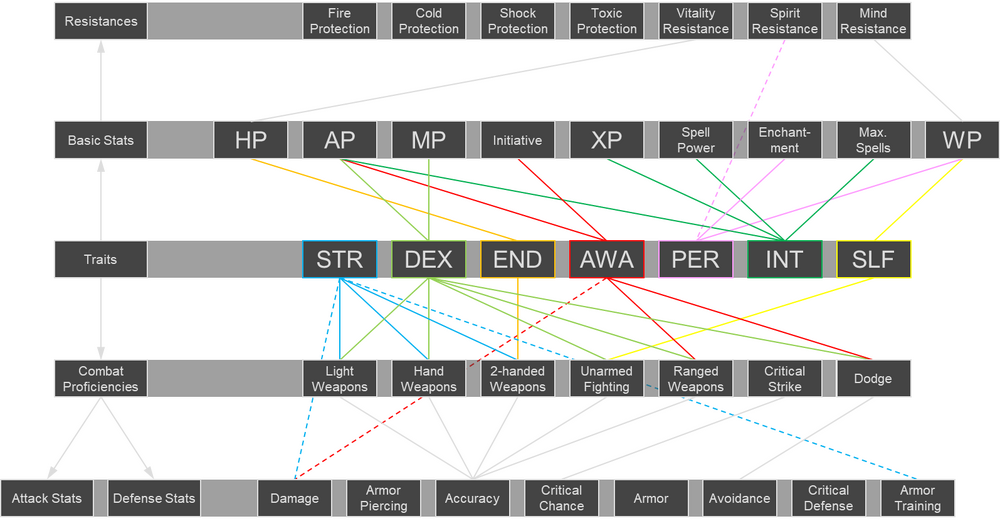
Archaelund is based on a complex rule-system where characters are not only defined by their Race, Traits and Careers, but also by a huge number of derived stats. The interplay between a character's Traits and those stats is depicted in the following scheme and the meaning of the individual properties is explained below.
Basic Stats
- Health Points (HP): Damage the character can sustain before being seriously wounded or killed. Recovered by resting as well as natural or magical healing.
- Willpower (WP): Required to cast spells and use some special abilities. Replenished by resting. Fear and some special attacks may cause temporal loss of Willpower. If depleted, a character becomes demoralized, suffering penalties.
- Experience Points (XP): Represent the evolution of a character and are gained by solving quests, defeating enemies in combat, passing skill checks, and various other actions. At certain XP thresholds, the character advances to a new level.
- Action Points (AP): During turn-based combat, all actions require spending APs.
- Movement Points (MP): Similar to Action Points, but can only be used for movement.
- Initiative: In combat, turn order is defined by a random value (1...10) plus a character's Initiative. The side initiating combat will get an additional +3 bonus.
- Spell Power (SP): Allows casting some spells with greater potency (usually the ones that roll dice for effect such as damage spells). The description of each spell explains if it is affected by SP.
- Enchantment: A spellcasters ability that makes spells harder to resist. It only affects spells that can be resisted entirely, but has no effect on elemental damage spells or other spells that have no resistance listed in their description.
- Max. Spells: The maximum number of spells a character is able to learn for each of the five ranks of magic. Rank I spells are considered "apprentice", while rank II or III are "proper" magic. Rank IV and V spells are rare, mastered only be the most powerful spellcasters.
- Directly determined by INT minus the spell rank
Combat Proficiencies
 Light Weapons: Chance to hit with daggers, short swords and light warhammers.
 Hand Weapons: Chance to hit with a wide range of melee weapons, such as longswords, axes, or maces.
 2-Handed Weapons: Chance to hit with weapons wielded with two hands, such as greatswords, spears, mauls, or great-axes.
 Unarmed Fighting: Chance to hit when fighting unarmed.
 Ranged Weapons: Chance to hit with bows, crossbows, and thrown weapons.
 Critical Strike: Base chance to critically hit an enemy after a successful attack.
- Base value of 10% (no further modifiers)
- Increased at each new character level according to the chosen Career
 Dodge: Reduces the chance of being hit in combat. After all other modifiers are applied, Dodge is reduced by 50% if wearing heavy chest armor or by 20% if wearing light chest armor.
Attack Stats
 Damage: Base damage inflicted on an enemy in case of a successful attack. May further be reduced by enemy armor and resistances.
 Accuracy: Base chance of a successful hit during combat. Is reduced by an enemies Avoidance and increased when attacking from a flank (+15%) or the rear (+30%).
- Directly derived from the corresponding Combat Proficiency (depending on the type of the equipped weapon)
- Can further be modified by the properties of the equipped weapon
 Critical Chance: Base chance of dealing a critical hit in case of a successful attack. Is reduced by an enemies Critical Defense. Criticals deal 100...150% of maximum damage and have sometimes additional effects.
- Directly derived from the Critical Strike proficiency
- Can further be modified by the properties of the equipped weapon
 Armor Piercing: The amount of enemy armor ignored upon a successful hit.
- Exclusively determined by the equipped weapon
Defense Stats
 Armor: 50...100% of this value is subtracted from all physical attacks, although a minimal amount of damage may still go through. Armor does not protect from special damage sources such as fire or poison (where resistances are used instead).
- Exclusively determined by the worn equipment
 Avoidance: Reduces the Accuracy of incoming attacks. Avoidance is halved when a character is flanked and ignored entirely when attacked from the rear.
- Directly derived from the Dodge proficiency
- Can be increased by shields and certain Talents
 Critical Defense: Reduces the Critical Chance of incoming attacks.
- Exclusively determined by the worn equipment
 Armor Training: Wearing armor efficiently requires a total Armor Training equal or higher than the Bulk stat of the worn armor, which ranges from 1 (for the lightest leather jerkins) to near 10 (for the heaviest full plate armors).
Resistances
 Fire Protection: Reduces a given number of damage points per round caused by fire attacks.
 Cold Protection: Reduces a given number of damage points per round caused by cold attacks.
 Shock Protection: Reduces a given number of damage points per round caused by shock attacks.
- Can be increased by special equipment as well as buffs from spells and potions
- Negative values represent a vulnerability and double the damage from shock attacks up to this value
 Vitality Resistance: Chance to resist poisons and other noxious effects.
- Base value equals half of the maximum HP
- Can be increased by special equipment as well as buffs from spells and potions
 Spirit Resistance: The ability to resist certain mystic effects such as curses or death magic.
- Base value determined by PER × 4%
- Can be increased by special equipment as well as buffs from spells and potions
 Mind Resistance: Chance to resist mental attacks and effects.
- Base value equals half of the current Willpower
- Can be increased by special equipment as well as buffs from spells and potions
